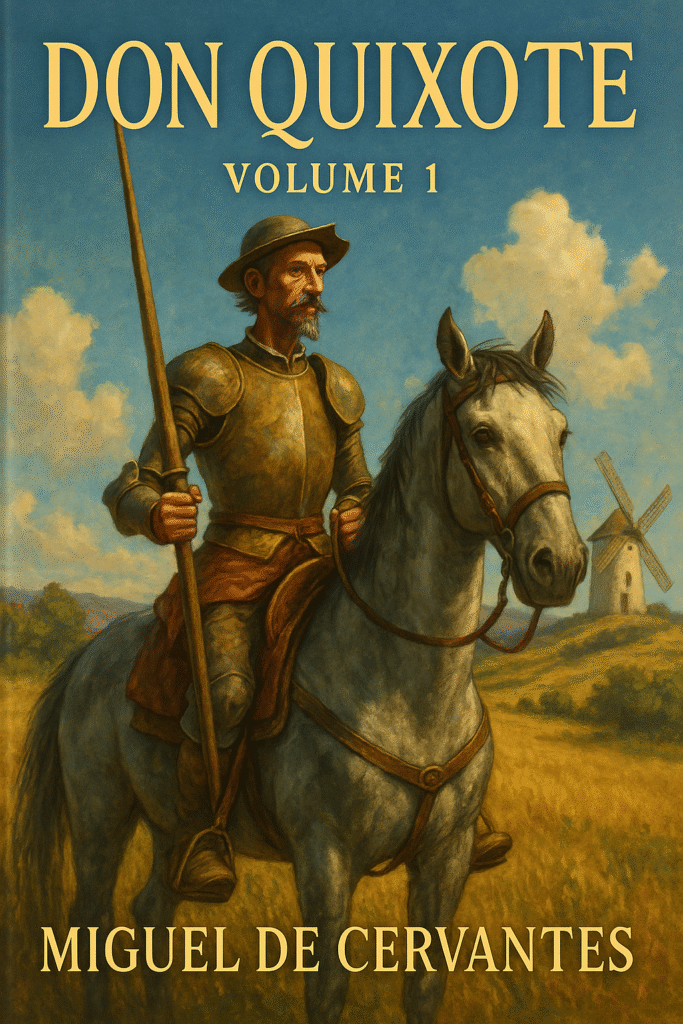
Miguel de Cervantes (1547–1616) was a Spanish writer widely regarded as one of the greatest novelists in Western literature. Born in Alcalá de Henares, Spain, Cervantes’s early life was marked by financial hardship and military service. He fought in the Battle of Lepanto in 1571, where he sustained a debilitating injury that left his left hand crippled. His later life was fraught with more challenges, including captivity by pirates for five years and financial instability. Yet, these struggles infused his work with a profound understanding of human resilience, folly, and humour.
Cervantes is most renowned for his masterpiece Don Quixote, published in two parts (1605 and 1615). The novel is considered the first modern European novel and is beloved for its satirical yet deeply human portrayal of idealism and reality. The story follows the misadventures of an aging nobleman, Don Quixote, who, inspired by tales of chivalry, sets out as a self-styled knight-errant. Accompanied by his loyal squire, Sancho Panza, Quixote’s attempts to revive chivalry often lead to humorous and poignant encounters. Readers are drawn to the novel for its rich tapestry of characters, its wit, and its exploration of themes like illusion versus reality, the nature of heroism, and the pursuit of one’s dreams against the odds.
Cervantes’s writing style in Don Quixote is a masterful blend of parody, irony, and pathos, making it both entertaining and profound. He deftly combines farcical episodes with moments of deep introspection, allowing readers to laugh at the absurdity of Quixote’s quest while simultaneously admiring his unwavering commitment to his ideals. This balance between comedy and tragedy is one reason why the novel remains universally admired.
Readers love Cervantes’s work for its timeless insight into the human condition. Don Quixote transcends cultural and historical boundaries, speaking to the heart with its portrayal of hope, ambition, and the enduring spirit of adventure. Cervantes’s legacy is that of a literary pioneer who forever changed storytelling, making him an enduring icon in world literature.