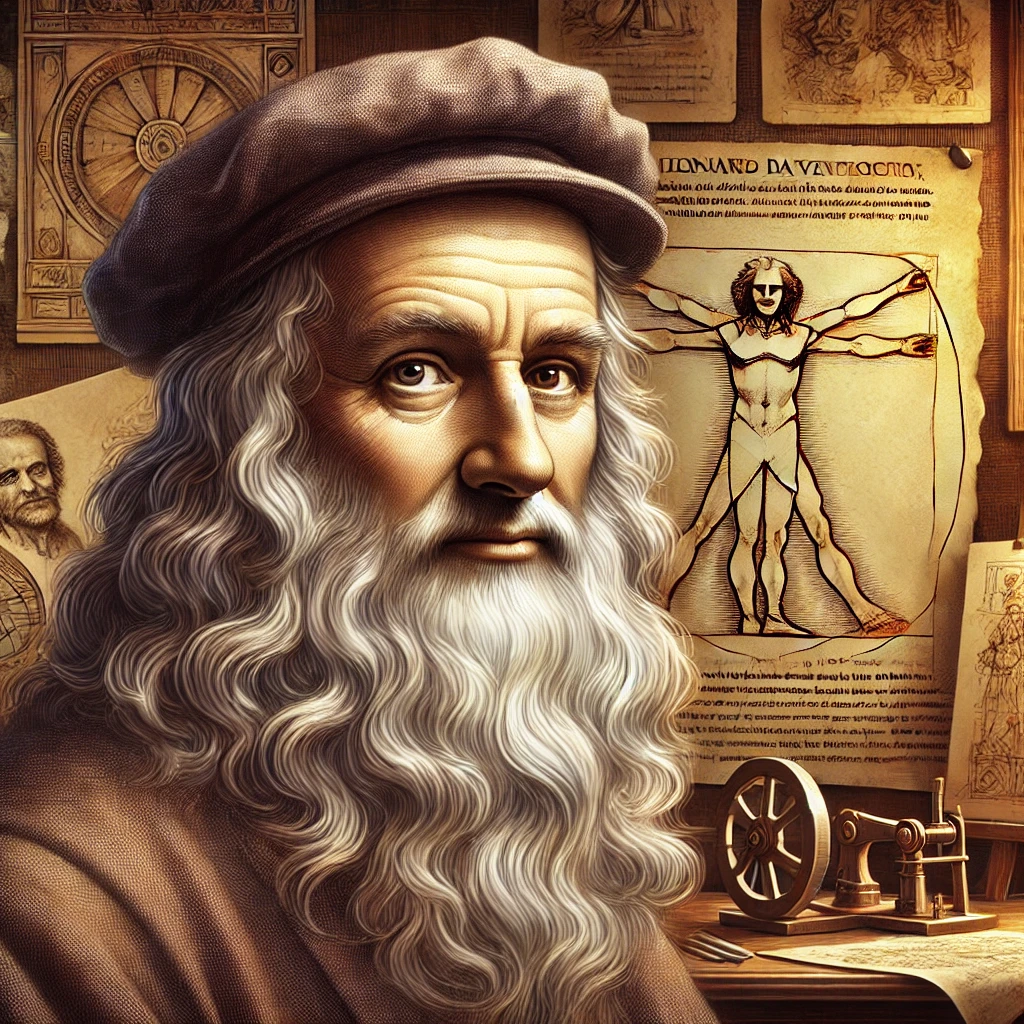
Leonardo da Vinci (1452–1519) was an Italian polymath whose legacy encompasses an extraordinary range of fields, including art, science, engineering, anatomy, and philosophy. Born in Vinci, a small town in the Republic of Florence, Leonardo was the illegitimate son of a notary and a peasant woman. His early years were marked by a curiosity that would later define his life’s work. Apprenticed in Florence under the artist Andrea del Verrocchio, Leonardo’s artistic talent quickly became evident, laying the groundwork for masterpieces that would immortalize him.
Leonardo is most celebrated for his iconic paintings, such as The Last Supper and Mona Lisa, works renowned for their revolutionary use of perspective, light, and anatomy. However, his contributions extend far beyond art. His notebooks, filled with meticulously detailed sketches, observations, and musings, reveal the mind of a man far ahead of his time. These notebooks explore subjects as diverse as human anatomy, flight, mechanics, and botany. Readers are captivated by Leonardo’s insatiable curiosity and the profound insights he brought to every subject he touched. His ability to merge art and science seamlessly showcased his belief that all aspects of knowledge were interconnected.
Leonardo’s writing style, predominantly found in his notebooks, was marked by concise, observational prose accompanied by intricate illustrations. Written in his trademark mirror script, these works were a blend of practical instruction, theoretical inquiry, and personal reflection. His inquisitive nature and the holistic approach to understanding the world resonate with readers and scholars alike, making him an enduring symbol of the Renaissance ideal.
Leonardo da Vinci’s genius lay not only in the perfection of his art but in his boundless exploration of the mysteries of life. His legacy continues to inspire for its demonstration of the limitless potential of human intellect and creativity.